
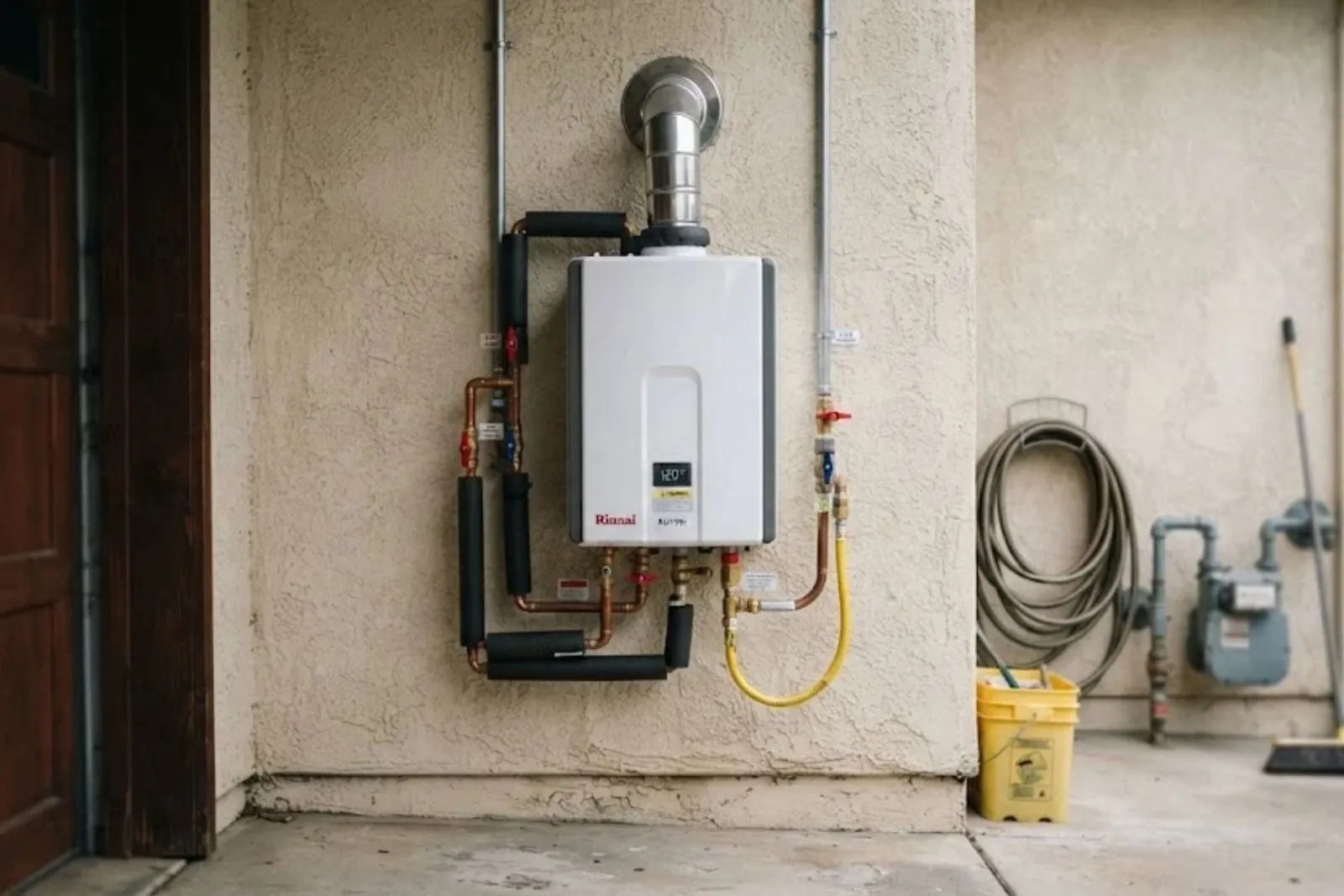
What an exterior tankless unit is
.Exterior models are built with weather-resistant cabinets and are mounted on a wall outside the house. Water and gas lines run through the wall, and the unit vents directly to open air.
The attraction is simple. You gain closet space, avoid long vent runs and keep combustion air outside the house.
The freeze problem
.Water in an outdoor unit and its pipes can freeze when temperatures drop. Most exterior tankless heaters have built-in freeze protection, which uses small heaters to keep internal parts above freezing, but that protection depends on electricity.
A power outage in a cold snap can leave the unit unprotected. If you are considering an exterior unit, ask the maker about its freeze protection limits, and ask whether the unit has to be drained when the power fails for a long time.
Exterior or interior: how they compare
.The right place depends on the house and the winter.
| Factor. | Exterior. | Interior. |
|---|---|---|
| Space. | Frees up indoor space. | Uses closet or basement space. |
| Venting. | Direct to outside air, usually simple. | Needs a vent through a wall or roof. |
| Freeze risk. | Higher, depends on electricity. | Low in a heated space. |
| Service access. | Weather affects maintenance days. | Easy in any weather. |
| Pipe runs. | Longer exposed lines need insulation. | Shorter lines inside. |
| Appearance. | Visible on the wall. | Hidden. |
Would you rather hand this one to a plumber? Call and get a clear price before work starts.
Call (603) 815-9179.Pipe insulation and protection
.Even with a protected unit, the pipes that connect to it are exposed. Wrap supply lines in insulation rated for outdoor use, protect the gas line and keep a drain valve accessible.
Think too about the location. A wall that receives drifting snow, a spot under a roof edge that drops ice or a place near a driveway where plows throw snow can all cause trouble. Pick a spot with clearance and shelter.
Gas, electric and permits
.A gas tankless unit needs a gas line sized for its burner, and an electrical outlet for the controls and freeze protection. An electric unit needs a heavy circuit.
Installation involves gas and electrical connections, so check with the Bedford building department about permits before work begins. Our tankless water heater service handles the plumbing side.
Water quality and filters
.Tankless units have small passages that sediment and scale can clog. An inlet filter protects the unit, and a yearly flush clears scale.
If you are on a private well, test the water before you buy. Sediment and iron shorten the life of any heater, and a filter ahead of the unit can protect it.
Maintenance, flushing and winter service
.Outdoor units need the same yearly flush as indoor ones, and winter makes the job harder. Plan the flush for a mild week, and keep the isolation valves accessible, not buried behind a snowbank.
Check the cabinet and the vent terminal after storms. Leaves, ice and snow can block the intake or exhaust, and a blocked terminal makes the unit shut down or throw an error code.
- Clear snow from around the cabinet after every storm.
- Inspect pipe insulation each autumn and replace any that has split.
- Keep the power supply on a reliable circuit, since freeze protection depends on it.
- Know where the isolation valves are so you can drain the unit if a long outage is coming.
What affects the cost
.Price depends on the specifics of your house.
If you are replacing a failed tank, see water heater installation to compare options.
Help from our Bedford crews
.From our Bedford office we also reach Amherst and Hooksett, and a dispatcher can tell you how soon a plumber can arrive. For the related service, see tankless water heater.
Bedford note: your water source and the unit
.ATSDR has said that some private wells in Bedford were affected by PFOA and PFAS tied to the Saint-Gobain plant in Merrimack, and it recommends that private well owners monitor or treat their water and test it.
That guidance concerns drinking water, not heaters, but a well test is a sensible step before any water-using appliance purchase because it tells you what the water carries.
Source type: federal public health agency fact sheet.
Common questions
.Do outdoor tankless heaters work in New Hampshire winters?
Many are built for cold weather and have freeze protection, but protection depends on power and has limits. Check the maker's rated temperature.
What happens in a power outage?
Freeze protection stops, and the unit may need to be drained if the outage is long. A backup power source or an indoor location avoids the risk.
Is an indoor unit safer in winter?
In general yes, because it sits in a heated space. The trade-off is venting and space.
Do I need a permit for an exterior install?
Ask the Bedford building department, since gas and electrical connections are involved.
Should I test my well before choosing a unit?
Yes. ATSDR recommends that private well owners in affected areas monitor or treat their water, and a lab test shows what a filter should address.
Standards and references
.Plumbing work follows published model codes such as the International Plumbing Code (IPC) from the International Code Council and the Uniform Plumbing Code (UPC) from IAPMO. The edition a town enforces is its own decision, so ask the Bedford building department which one applies to your project. For private wells, the New Hampshire Department of Environmental Services recommends testing every three to five years. The federal Agency for Toxic Substances and Disease Registry publishes guidance for private well owners in areas affected by PFAS.