
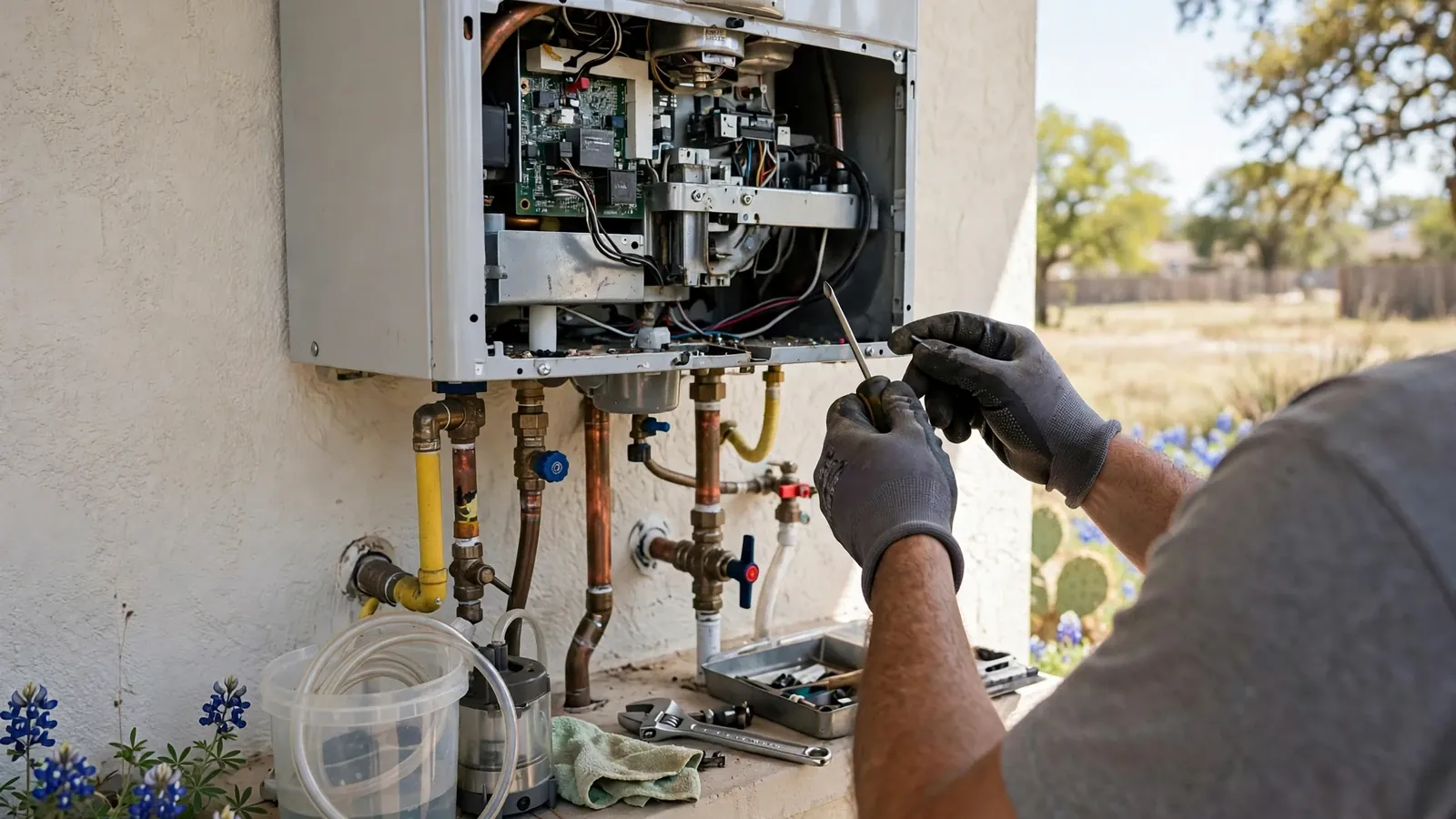
How a tankless heater works
.When you open a hot tap, flow sensors start a burner or heating elements, and the heat exchanger warms water to the setpoint on the way through. When the tap closes, the unit shuts off.
The catch is flow. A tankless unit can only heat so many gallons per minute for a given temperature rise. In winter, incoming water is colder, so the same unit delivers less hot water in January than in July.
Gas or electric
.Fuel changes the installation more than anything else.
| Question. | Gas tankless. | Electric tankless. |
|---|---|---|
| Heat output. | High, suits whole-house use. | Lower for whole-house, good for point of use. |
| Installation. | Larger gas line, venting through the wall or roof. | Heavy circuits, often a panel upgrade. |
| Venting. | Required, sealed combustion models are common. | Not required. |
| Running cost. | Depends on the gas price. | Depends on the electric rate. |
| Service. | Annual flush, combustion check. | Annual flush, element check. |
A whole-house electric tankless may need more amperage than an older panel can give. We check the panel before you buy.
Replacing a tank with a tankless unit
.The swap is not always simple. A gas unit needs a gas line sized for the burner and a flue that meets the manufacturer's rules, and a condensing model needs a drain for acidic condensate.
Where it makes sense, we can show you the tank option alongside, such as a standard water heater installation, so you compare costs honestly. A tankless unit saves floor space and removes the risk of a tank failure, but it costs more to buy and install.
Flushing and descaling
.Minerals build up inside the heat exchanger, and a scaled exchanger works harder, makes noise and can fail early. Most manufacturers recommend flushing once a year with a descaling solution.
Hardness depends on your source. Manchester Water Works reported soft water at 19.35 mg/L for 2018, so scale builds slowly on that supply. Private wells vary, and NHDES recommends testing them every three to five years so you know what the heater is facing.
Common tankless problems
.Most calls come down to a short list.
- Cold sandwich, where hot water is interrupted by a cold stretch between uses.
- Error codes for ignition, flow or exhaust problems.
- Low flow caused by clogged inlet filters or scale.
- Water that never gets hot enough in winter.
- Condensate drain clogs on high-efficiency units.
If your unit is leaking or has stopped heating, water heater repair covers the diagnosis.
What affects the cost of tankless service
.The number depends on these factors.
Insurance does not usually cover planned installation or maintenance. Some utilities and state programs offer rebates, so check before you buy.
Call with your fuel, household size and current heater to get a clear price before work starts.
Call (603) 815-9179.Related services and nearby towns
.If you are replacing a failed tank, see water heater replacement. We service tankless units in Hooksett and the other towns we serve.
Common questions
.Is a tankless water heater worth it?
It depends on your household. You gain space and endless hot water in exchange for a higher upfront cost and yearly maintenance.
How often should a tankless heater be flushed?
Manufacturers commonly recommend once a year. Hard water may call for more often.
Why does my tankless heater give a cold burst?
A short interval between uses lets water in the pipes cool while the unit restarts. A recirculation loop or small buffer tank can reduce it.
Can I install a tankless unit myself?
Gas and electrical connections, venting and permits make this a job for a licensed plumber.
Does a tankless unit work during a power outage?
Most need electricity for the controls and fans, even gas models. A battery or generator backup is required to run it.
Do you service tankless units in other towns?
Yes. We serve Manchester, Merrimack, Goffstown, Amherst and Hooksett.
Standards and references
.Plumbing work follows published model codes such as the International Plumbing Code (IPC) from the International Code Council and the Uniform Plumbing Code (UPC) from IAPMO. The edition a town enforces is its own decision, so ask the Bedford building department which one applies to your project. For private wells, the New Hampshire Department of Environmental Services recommends testing every three to five years.