
Why a crawl space is different
.A basement has a poured floor and a drain. A crawl space often has bare soil or a thin concrete skim, tight clearance and no floor drain.
That changes everything. Digging space is limited, access is awkward and a pit liner must be placed in soil that may be wet. The goal remains the same, which is to collect water at one low point and pump it away.
Choosing the location
.Place the pit at the lowest spot, where water already gathers. Look at where moisture stains the soil, where the vapor barrier is damp and where water enters from outside.
Keep the pit away from support piers and footings so you do not undermine them, and leave room around it to service the pump. A pit near an access hatch makes later maintenance far easier.
Building the pit
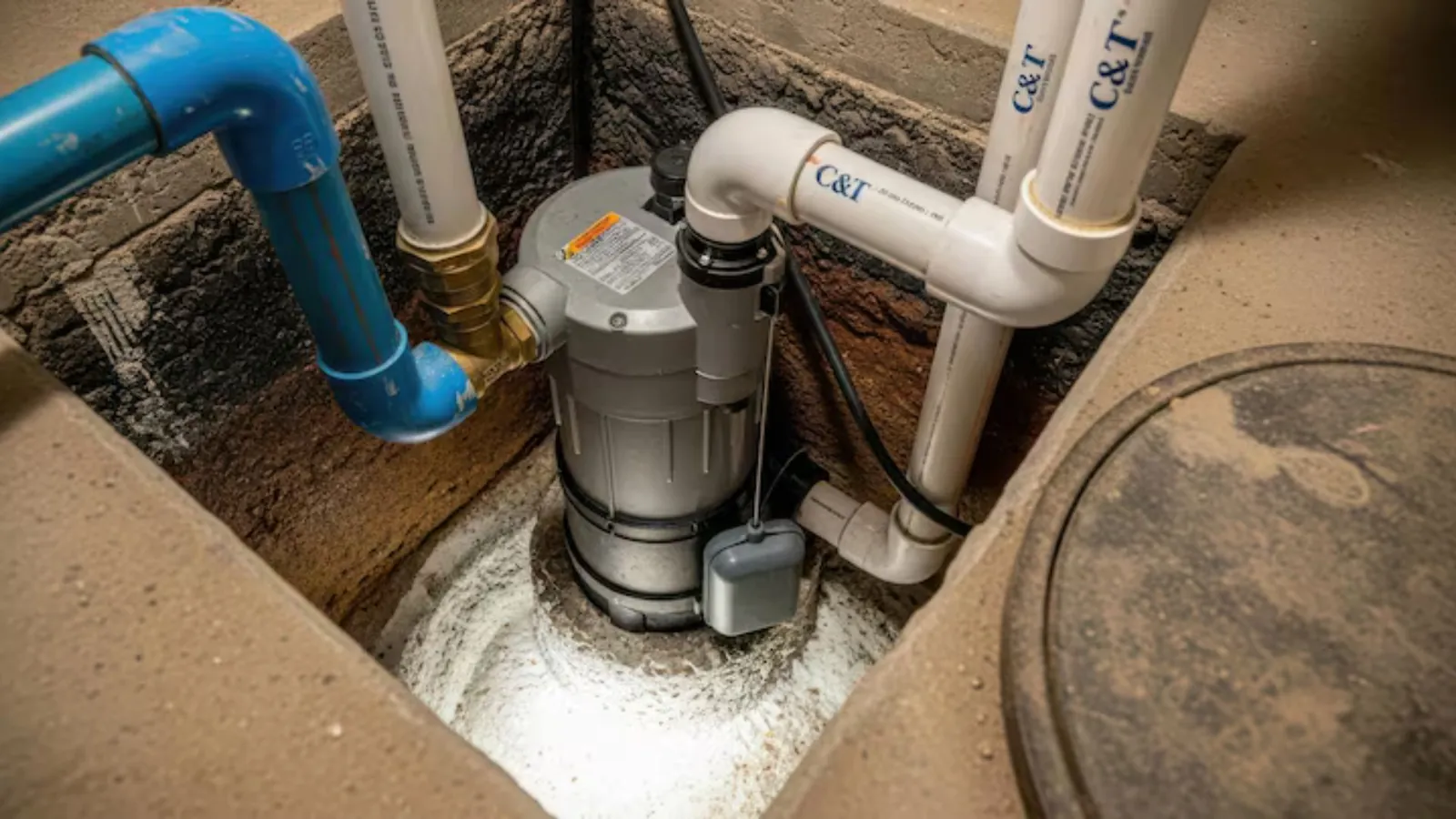
.A basin keeps the pit from collapsing and gives the pump a clean place to sit.
- Dig a hole slightly larger than the liner, deep enough that the rim sits at or just below the grade.
- Add a layer of gravel at the bottom for drainage and stability.
- Set the liner level and backfill around it with gravel.
- Drill small weep holes if the liner allows, so groundwater can enter.
- Install the pump on a flat base, away from the sides, and add a check valve on the discharge.
- Cover the pit with a sealed lid to keep humid air and radon from entering the space.
Would you rather hand this one to a plumber? Call and get a clear price before work starts.
Call (603) 815-9179.Discharge: where the water goes
.The discharge line must carry water away from the foundation, downhill and to a place where it will not run back. Never discharge into a sanitary sewer or a septic system.
- Run the pipe out of the crawl space through a sealed penetration.
- End it at least several feet from the foundation, on a slope away from the house.
- Use a freeze-resistant discharge in winter, or a pop-up emitter that opens under pressure.
- Protect the exit so rodents and debris cannot block it.
A frozen discharge is a common failure. If the line ices over, the pump runs, the pit fills and the water goes where you do not want it.
Moisture control around the pump
.A pump handles liquid water. It does not fix vapor. A ground vapor barrier laid over the soil and sealed at the walls cuts evaporation, and sealed vents and a dehumidifier can control the air.
For ongoing water problems, basement waterproofing covers drainage and grading plans, and sump pump installation and repair covers new pits and replacements.
When to call a plumber
.A crawl space pit is a tight, wet and dirty job. Call a plumber if the pit must be cut through concrete, if the discharge must cross a long distance, if you want a battery backup or if the space has wiring near the pit.
Electricity and water do not mix, and a pump should be on a ground-fault protected circuit. A plumber can also check for plumbing leaks that might be adding to the water, a job for leak detection.
What affects the cost
.Pricing depends on access and the scope of the system.
Help from our Bedford crews
.From our Bedford office we also reach Goffstown and Merrimack, and a dispatcher can tell you how soon a plumber can arrive. For the related service, see sump pump installation and repair.
Bedford note: check the flood map for your lot
.Bedford is bordered by the Merrimack River, and it has Sebbins Pond, the town's largest body of water after the river. A property near either may have different groundwater and flood conditions from a hillside lot.
FEMA publishes flood maps through its Map Service Center, and you can look up your address there. Ask the Bedford town office about floodplain rules before you dig or change drainage near water.
Source type: federal flood map service and municipal floodplain contact.
Common questions
.Do I need a sump pump in a crawl space?
If the crawl space holds standing water or the soil is saturated, yes. If it is merely humid, a vapor barrier and a dehumidifier may be enough.
Can I use the same pump as in a basement?
Yes, submersible pumps work in both, but the pit and discharge must fit the space.
Where should the water go?
Away from the foundation and downhill. Never into the sewer or septic system.
Why do I need a lid on the pit?
The lid keeps humid air, radon and critters out of the crawl space.
Is my Bedford lot in a flood zone?
Check the FEMA flood map for your address and ask the Bedford town office. Properties near the Merrimack River or Sebbins Pond deserve a look.
Standards and references
.Plumbing work follows published model codes such as the International Plumbing Code (IPC) from the International Code Council and the Uniform Plumbing Code (UPC) from IAPMO. The edition a town enforces is its own decision, so ask the Bedford building department which one applies to your project.