
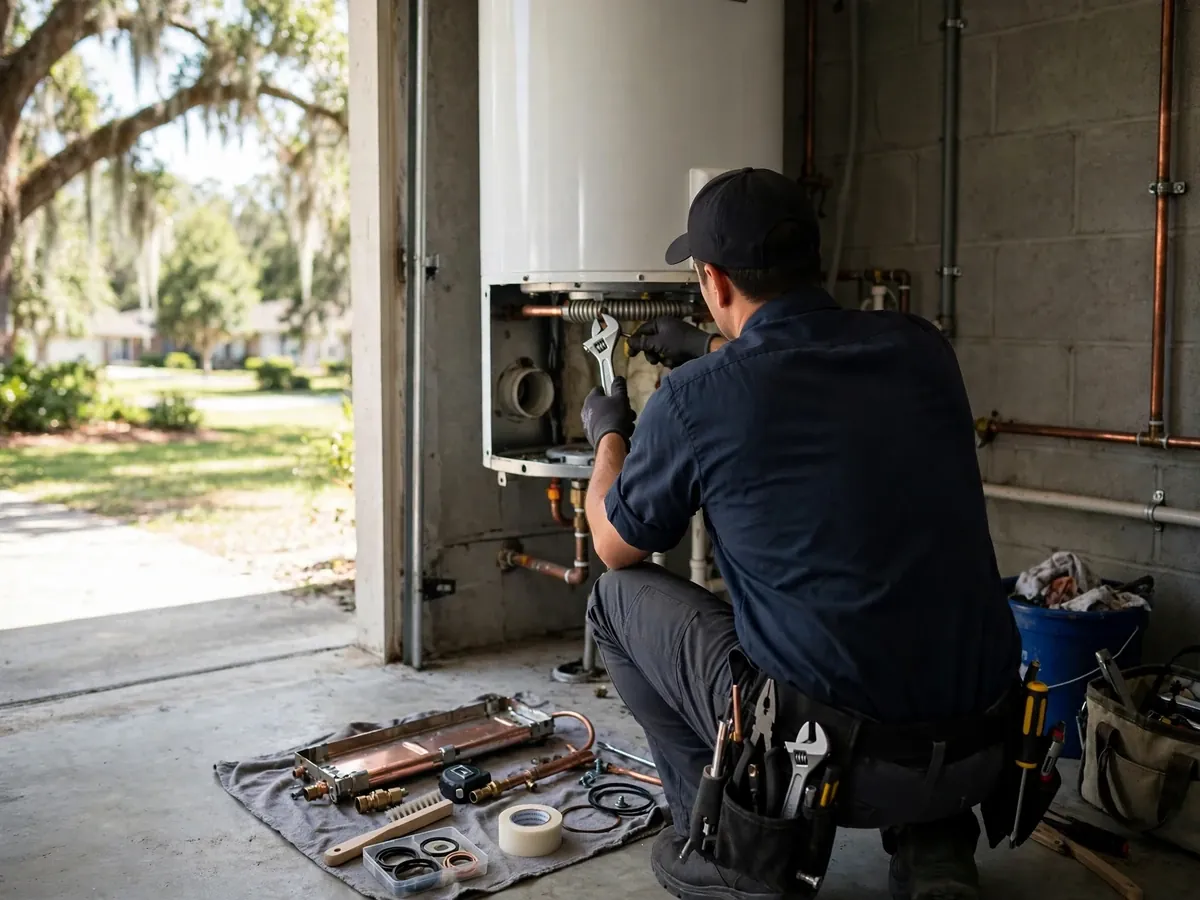
How to tell a bad element from other problems
.Most electric tanks have two elements, one near the top and one near the bottom, each controlled by a thermostat. The symptom tells you which is likely at fault.
| Symptom. | Likely cause. |
|---|---|
| No hot water at all. | Tripped breaker, tripped high-limit switch or failed upper element. |
| Hot water that runs out quickly. | Failed lower element. |
| Lukewarm water. | Failed element or a thermostat set too low. |
| Popping or rumbling. | Sediment on the tank floor. |
| Water leaking from the tank body. | Failed tank, not an element. |
A leak from the tank means replacement, not repair. See water heater repair for a diagnosis.
Safety first
.Water heaters run on 240 volts, which can kill. Switch off the breaker, then confirm with a non-contact tester and a multimeter that the unit is dead before you touch any wire.
If you cannot do that with confidence, or if your panel is not clearly labeled, stop and call a plumber or electrician. A mistake here is not worth the saving.
Testing the element
.Remove the access panel and the insulation behind it, then the thermostat cover. Disconnect the element wires and set a multimeter to resistance.
A good element reads a few ohms, depending on its wattage. A reading of infinity means the element is open and has failed, and a reading near zero from the element terminal to the tank wall means it has shorted. Either result means replace it.
Would you rather hand this one to a plumber? Call and get a clear price before work starts.
Call (603) 815-9179.Replacing the element
.Drain the tank below the element's height before you unscrew it, or the tank will empty into the room.
- Turn off the breaker and the cold-water supply.
- Open a hot tap upstairs and drain the tank until water is below the element.
- Unscrew the old element with an element wrench.
- Clean the opening, install the new element with a fresh gasket and tighten it.
- Reconnect the wires and thermostat cover, then close the drain.
- Refill the tank fully with a hot tap open until water runs steadily, and only then restore power.
Turning on power before the tank is full burns out the new element within seconds. This is the most common reason a replacement fails.
What the element failure tells you
.One failed element on a tank that is a few years old is a simple repair. Two failures in a short period, or an element encrusted with scale, suggest sediment or hard water, and a flush of the tank is worth doing.
If the tank is past about 12 years, or if you see rust at the base, weigh replacement. A planned swap such as water heater replacement is better than a failure in the middle of winter.
Flushing the tank and checking the anode rod
.While the tank is drained for the element, it is a good moment to flush sediment. Open the drain valve into a bucket, let it run until the water clears and watch what comes out. A lot of grit or flakes means the tank has been collecting sediment for years.
The anode rod is a sacrificial metal rod inside the tank that corrodes so the tank does not. If you can remove it, check its condition. A rod that is mostly bare steel wire is spent, and replacing it can add years to the tank.
What affects the cost of a professional replacement
.A plumber's price depends on the following.
Help from our Bedford crews
.The same crews that serve Bedford respond to calls in Merrimack and Amherst, so help is a phone call away. For the related service, see water heater repair.
Bedford note: well water and your heater
.NHDES recommends that private well owners test their water every three to five years, and it says radon and arsenic are the most common contaminants. Testing is not required by the state, though lenders and towns sometimes require it.
A lab test also shows hardness and iron, the minerals that coat elements and shorten their life. If your elements fail often and you are on a well, the test is a better first step than another part.
Source type: state environmental agency guidance on private wells.
Common questions
.Can I replace a heating element myself?
If you are comfortable testing for power, draining the tank and working with wiring, yes. If any of those steps is uncertain, call a plumber.
How long does an element last?
Elements commonly last for years, though sediment and hard water shorten their life. A failure inside a few years suggests a water quality problem.
Why did my new element burn out immediately?
Power was likely turned on before the tank filled, so the element ran dry. Always refill before restoring power.
Do I need to replace both elements?
Not always, but when one fails and the other is old, replacing both avoids a repeat visit.
Does well water in Bedford shorten element life?
It can, if the water is hard or high in iron. NHDES recommends testing private wells every three to five years, and the result tells you whether a filter or softener would help.
Standards and references
.Plumbing work follows published model codes such as the International Plumbing Code (IPC) from the International Code Council and the Uniform Plumbing Code (UPC) from IAPMO. The edition a town enforces is its own decision, so ask the Bedford building department which one applies to your project. For private wells, the New Hampshire Department of Environmental Services recommends testing every three to five years.