
Check the water meter
.The meter is the single best leak detector in the house. It measures everything that passes through it, so if it moves when you are using no water, water is going somewhere.
- Turn off every faucet and appliance, including the ice maker.
- Read the meter or watch the small leak indicator on the dial.
- Wait 30 minutes without using any water.
- Read it again. Movement means a leak.
- Close the main shutoff and check again. If it stops moving, the leak is inside. If it keeps moving, the leak is between the meter and the house.
If you are on a private well, listen to the pressure tank. If the pump cycles on when nothing is running, water is leaking from the system.
Check the toilets
.Toilets leak silently, and they are the most common source of a high bill.
- Add a few drops of food coloring to the tank and wait 15 minutes without flushing.
- If color appears in the bowl, the flapper is leaking.
- Listen for hissing or a tank that refills on its own.
- Check the base of the toilet for dampness.
A flapper replacement is cheap. Left alone, it can add a surprising amount to your bill, and our toilet repair service fixes it.
Look for signs in the house
.Water leaves a trail. Walk through the house and look for the following.
| Sign. | Where to look. | What it can mean. |
|---|---|---|
| Brown or yellow stain. | Ceilings and walls. | A leak above, often from a bathroom or roof. |
| Peeling paint or bubbling drywall. | Walls near plumbing. | Moisture inside the wall. |
| Musty smell. | Basements, closets, under sinks. | Hidden dampness. |
| Warped or soft flooring. | Under sinks and near tubs. | A slow leak below the surface. |
| Warm spot on a floor. | Slab or lower level. | A hot water line leaking. |
| Mold or mildew. | Corners and cabinets. | Long-term moisture. |
Would you rather hand this one to a plumber? Call and get a clear price before work starts.
Call (603) 815-9179.Check outdoors and the yard
.A leak in the supply line between the street and the house shows up outside. Look for a patch of lawn that is greener, soggy or sunken, and for water pooling along the foundation when it has not rained.
Check hose bibs for drips and the irrigation system for broken heads. For a buried line, water line repair fixes the break once it is found.
When to call for professional leak detection
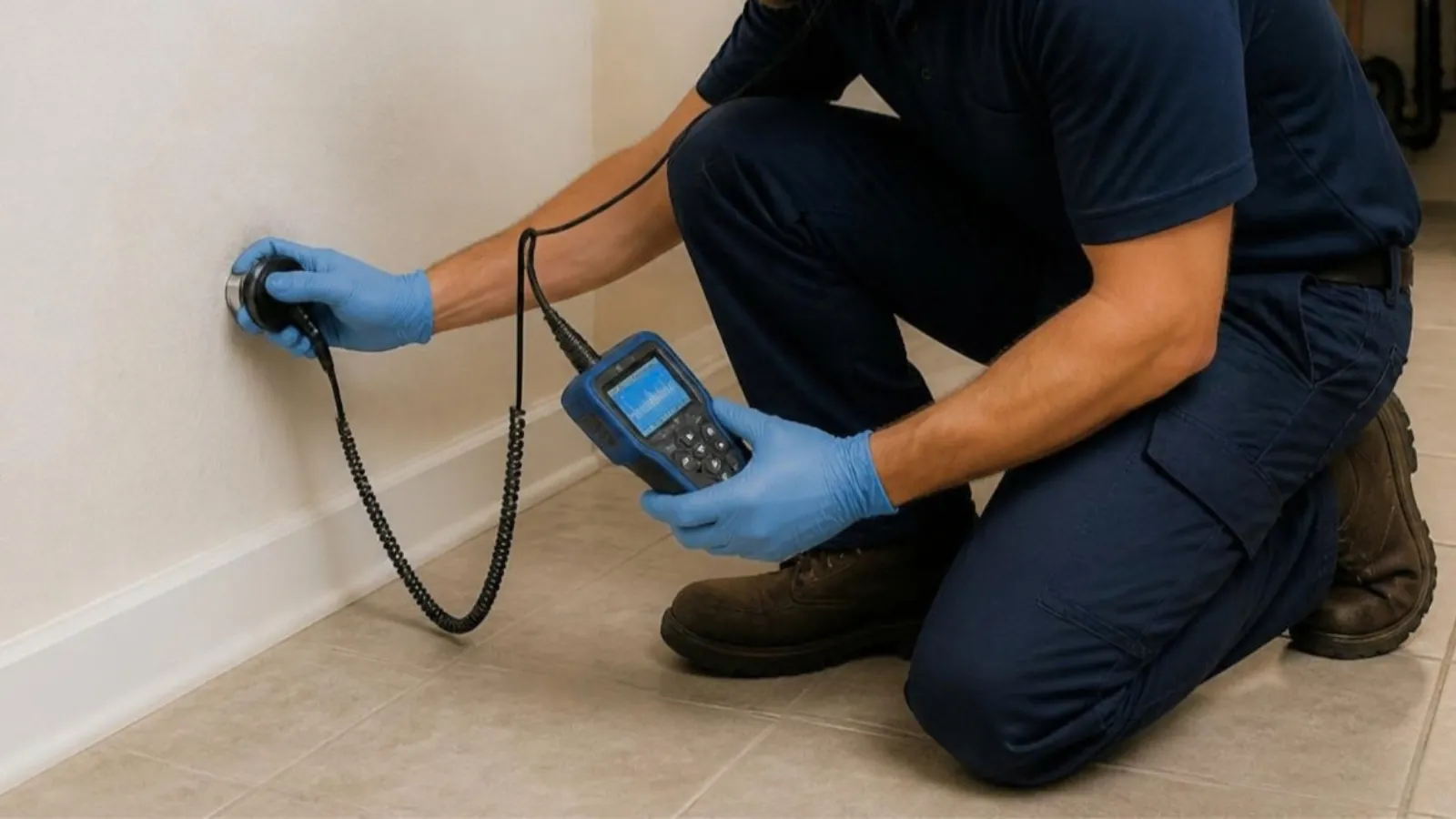
.If your checks show a leak but you cannot find it, a professional has tools you do not. Acoustic devices listen for the sound of escaping water, thermal cameras show temperature differences behind walls, and pressure tests isolate sections of pipe.
That is the job of leak detection. If the leak is already causing damage, close the main shutoff and call the 24/7 line before the water spreads.
Leaks that show up only in winter
.In New Hampshire, many leaks show up in the cold months. Pipes in unheated spaces can crack when water inside freezes, then leak only after the thaw, when the ice no longer plugs the split.
If a stain appears a day or two after a freezing night, suspect a split pipe in a wall or ceiling. Close the main shutoff, open a faucet at the lowest point to drain the lines and call. Do not wait for the stain to grow, because water behind a ceiling can bring drywall down.
Check hose bibs too. A bib that was left connected to a hose in autumn can freeze and split inside the wall, and the water only escapes when you turn it on in spring.
What affects the cost of finding a leak
.Detection is priced by the search required.
Help from our Bedford crews
.Our plumbers travel from Bedford to Goffstown and Manchester as well, so the same 24/7 line covers homes there. For the related service, see leak detection.
Bedford note: public water or a well
.ATSDR notes that Manchester Water Works mains already run in the South River Road area of Bedford, where private wells were affected by PFAS, and that 61 properties plus 23 additional homes were involved in that area.
That tells you the first question to answer. If you are a public water customer, the utility can tell you about your meter. If you use a private well, there is no meter, so the pressure tank and pump behavior are your clues.
Source type: federal public health agency fact sheet.
Common questions
.How much water can a small leak waste?
A steady drip can waste thousands of gallons a year, and a running toilet wastes far more. A meter test shows whether a leak exists.
Can I find a leak behind a wall myself?
Sometimes, by looking for stains, feeling for warmth and doing a meter test. Pinpointing the exact spot usually needs acoustic or thermal tools.
Does homeowners insurance cover a leak?
Many policies cover sudden water damage but not slow leaks or the cost of the pipe. Ask your insurer before work starts.
Do I have a meter if I am on a well?
No. Use the pressure tank. If the pump cycles when nothing is running, water is escaping somewhere.
Which part of Bedford is on Manchester Water Works?
ATSDR says its mains run in the South River Road area. For your address, ask the utility or the Bedford town office.
Standards and references
.Plumbing work follows published model codes such as the International Plumbing Code (IPC) from the International Code Council and the Uniform Plumbing Code (UPC) from IAPMO. The edition a town enforces is its own decision, so ask the Bedford building department which one applies to your project. For private wells, the New Hampshire Department of Environmental Services recommends testing every three to five years. The federal Agency for Toxic Substances and Disease Registry publishes guidance for private well owners in areas affected by PFAS.